What Even Is a Mini Fridge? (And Why You Probably Need One)
A mini refrigerator is exactly what it sounds like. A smaller version of your kitchen fridge. But here’s the thing—not all mini fridges are created equal.
Some are just for drinks. Some can actually keep food safe. Some have freezers that work. Some have freezers that are basically useless.
Here’s who actually needs one:
- College students who don’t want to walk to the communal kitchen at 2 AM
- Office workers are tired of mystery leftovers in the break room fridge
- Couples fighting over fridge space (we see you)
- Skincare obsessives who know their serums last longer when chilled
- Gamers who want drinks within arm’s reach during marathon sessions
- Anyone with a tiny apartment and a kitchen the size of a closet
The compact mini fridge market has exploded lately. You can get basic models for under $100. Fancy ones with smart features for $500+. But price doesn’t always mean quality.
I tested a $89 model last year that outperformed a $300 one from a “premium” brand. Wild, right?
| Brand | Standout Model (2026) | Capacity / Type | Noise Level | Energy Use | Key Feature | Best For |
|---|---|---|---|---|---|---|
| GE | GFSS2639FZ (3.2 cu ft) | Compact fridge + true freezer drawer separate door | ≤39 dB(A) (whisper-quiet) | 172 kWh/year ENERGY STAR | dual‑evaporator cooling (zero odor transfer, precise 0°F freezer) [citation:5] | bedrooms / studios / home offices needing real freezer |
| Midea | WHS‑65LFW / Midea 1.6 cu ft | 1.6–1.9 cu ft / top freezer or freezerless | ≤37 dB dorm‑quiet | 187–194 kWh/year (inverter comp.) | frost‑free operation + ultra‑slim 18.5″ width; adaptive compressor [citation:6][citation:10] | shared dorms / bedrooms / RVs (noise‑sensitive) |
| Whirlpool | WRT318FZDM / Icemagic Powercool | 3.5 cu ft / single door + freezer | ~41 dB (adaptive defrost cycle) | ≤210 kWh/year ENERGY STAR | FreshFlow™ air filtration + 12‑hour cooling retention during outages [citation:5][citation:7] | apartments / areas with power cuts |
| Danby | DUFM053A2WDB / Designer 5.3 cu ft | 5.3 cu ft upright / compact freezer or fridge | 41 dB (stable compressor) | 212 kWh/year Energy Star | true adjustable temperature control + commercial‑grade sealed system; 5‑year compressor warranty [citation:6][citation:10] | small families / home bars / supplemental storage |
| Avanti | RA31B3S (3.1 cu ft) | 3.1 cu ft / separate freezer compartment | ~40 dB (low ambient noise) | Energy Star certified (est. 200 kWh/year) | reversible door + automatic defrost + interior light + 2‑liter bottle storage [citation:2] | dorms / offices / she‑sheds on a budget |
Mini Fridge with Freezer: Actually Useful or Total Gimmick?
Here’s where things get real.
A mini fridge with a freezer sounds perfect. Frozen pizza! Ice cream! Ice cubes!
But most small freezer compartments are trash.
The truth about mini fridge freezers:
Most of them can’t actually freeze anything. They’ll keep things cold. Maybe make some sad ice cubes if you wait 12 hours. But actually freezing food? Good luck.
The issue is the compressor. Cheap mini fridges use weak compressors that can’t generate enough cold for a real freezer. The freezer compartment is just an afterthought. A tiny box with thin insulation that steals cold from the main fridge.
When it works:
Some higher-end models do it right. Look for “true freezer” or “separate freezer compartment” in the specs. These have better insulation and sometimes even a separate door. My VEVOR 3.2 Cu.Ft model actually keeps ice cream frozen solid . It’s possible. You just have to pay for it.
When it doesn’t:
Those cube fridges with the little freezer box inside? Yeah, that’s not a freezer. That’s a slightly colder shelf. Don’t trust it with anything you actually need frozen.
Best Mini Fridge for Bedroom: The Quiet Factor
Okay, picture this.
You’re finally falling asleep after a long day. The room is dark. You’re cozy.
Then the fridge kicks on.
BRRRRRRRRRRRRR.
Suddenly, you’re wide awake, staring at the ceiling, wondering if you can return a 40-pound appliance on Amazon.
This is why quiet matters.
The best mini fridge for bedroom use runs at 35 decibels or less. For reference, that’s quieter than a library. You shouldn’t hear it from your bed.
Models that actually deliver:
The VEVOR compact refrigerator runs at ≤35 dB. One reviewer said they put it in their master bedroom for a coffee station and “it’s very quiet” . That’s the kind of review you want.
The GE GFSS2639FZ tested at 39 dB(A) in real-world conditions . Still quiet enough for most people.
What destroys quiet:
Cheap compressors. Loose parts. Bad insulation. If you’re putting a mini fridge in a bedroom, don’t buy the cheapest option. Your sleep is worth the extra $50.
Also? Avoid thermoelectric models. They use fans that never shut up. Compressor models cycle on and off. Much better for sleeping.
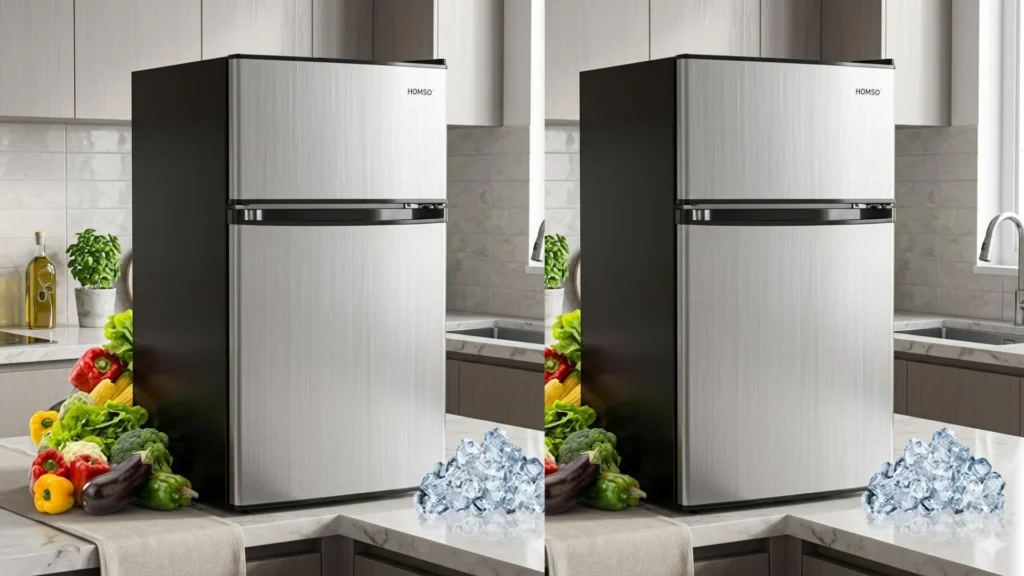
Best Mini Fridge for Office Use: The Social Dynamics
Offices are weird, right?
You put your lunch in the break room fridge, and suddenly it’s community property. Karen from accounting “borrowed” your yogurt again. Dave ate your leftover pizza. Again.
This is why an office mini fridge is a power move.
Having your own small refrigerator at your desk changes everything. Your food stays yours. No more Sharpie on everything. No more passive-aggressive notes.
What works for offices:
You want something small. Under 2 cubic feet usually. Quite obviously, coworkers will hate you if it hums all day. And stable temperature control because you’re not checking it constantly.
The BougeRV Rocky 40 is overkill for most offices (40 liters is huge), but it shows how good portable options have gotten . For a desk, you want something smaller.
The unspoken rule:
Don’t get one so nice that people want to use it. Basic is better. You want the office mini fridge that’s just okay enough that nobody asks, “hey, can I put my stuff in yours?”
Trust me on this.
Energy Efficient Mini Fridge: Saving Money Without Trying
Here’s a number that surprised me.
A full-size fridge can use 300 to 800+ kWh per year. A dorm fridge? Usually 100 to 250 kWh . That’s real savings.
But not all mini fridges are created equal.
What efficiency actually means:
An energy-efficient mini fridge has three things:
- Good insulation (thicker walls)
- An efficient compressor (inverter technology helps)
- A tight door seal (test it with a dollar bill)
The ENERGY STAR label matters. The 2026 requirements say units under 7 cubic feet should use ≤225 kWh/year . Models like the Whynter CUF-110B use only 172 kWh/year . That’s barely anything.
The math:
Let’s say electricity costs $0.15 per kWh.
- Inefficient model: 250 kWh/year = $37.50/year
- Efficient model: 170 kWh/year = $25.50/year
You save about $12 per year. Not huge. But over 10 years? That’s $120. Plus, you’re helping the planet. Win-win.
One weird trick:
Door seal integrity matters more than you think. Poor seals cause up to 22 kWh/year extra usage . Clean your seals. Check them regularly. It’s free efficiency.
Portable Mini Fridge: Taking Cold on the Road
Road trips change when you have a portable mini refrigerator.
No more warm sodas. No more melted cheese. No more stopping at overpriced gas stations for ice that’ll be water in six hours.
The game-changer:
Compressor coolers are the real deal. Unlike those thermoelectric coolers that barely cool below ambient temperature, these actually freeze things.
The BougeRV CRD2 40 runs on 12V from your car, 110V from a wall, or even solar panels . It has two compartments. One can be a fridge, one a freezer. Independently controlled. That’s wild.
The catch:
They’re heavy. The BougeRV Rocky 40 weighs almost 42 pounds empty . Fully loaded? Good luck carrying it anywhere alone. And they’re expensive—$350 to $500 easily.
Who actually needs one:
- Campers and van-lifers
- People with boats
- Truckers
- Anyone who tailgates seriously
- Families who road trip with picky eaters
For everyone else? A good cooler with ice packs is probably fine.
Small Fridge for Dorm Room: The College Survival Guide
Dorm life has rules. Some written. Some not.
The written ones: No candles. No hot plates. No space heaters.
The unwritten ones: Your mini fridge will be community property whether you like it or not.
What actually works in a dorm:
A small fridge for dorm room use needs three things: locks, adjustable shelves, and a freezer that sort of works.
The “best dorm mini fridge” category usually includes models from Midea, Haier, and GE. The Haier HFCU16DSS is a solid pick at 1.6 cubic feet . Big enough for snacks and drinks. Small enough to fit under most desks.
The freezer situation:
In a dorm, a mini fridge with a freezer compartment is useful for one thing: ice cream. Late-night study sessions demand ice cream. But that tiny freezer box won’t hold a full pint. Maybe a Haagen-Dazs mini cup. Maybe.
Pro tips from someone who survived dorm life:
Get a fridge with a reversible door. Dorm layouts are cramped. Being able to switch which way the door opens saves headaches .
Leveling feet matter. Dorm floors are never level. An uneven fridge won’t close right, and warm air gets in .
And yeah, get a lock. Even a cheap combination lock. Because that 2 AM pizza thief has no boundaries.
Mini Fridge for Skincare Products: Yes, It’s a Thing
This one surprised me.
But apparently, skincare people are serious about their serums. And some ingredients really do last longer when refrigerated.
Vitamin C serum. Retinol. Natural products without preservatives. They all degrade faster at room temperature.
What works for skincare:
You don’t need much. A mini fridge for skincare products can be tiny. Literally big enough for six cans of soda . Some are designed specifically for beauty products—cute colors, small footprint, consistent temperature around 45-50°F.
The Tropicool PortaChill is 5 liters. Fits two water bottles or six cans . Perfect for a bathroom counter if you have space.
The bathroom problem:
Bathrooms get humid. Humid + electronics = bad. Make sure your skincare mini fridge is rated for bathroom use or keep it in your bedroom. Nobody wants a shocked fridge and a ruined serum.
Temperature matters:
Skincare doesn’t need freezer-cold. Just cool. 45-50°F is perfect. Too cold and some products separate. Look for adjustable temperature control so you can dial it in .
Mini Fridge Under $100: Can You Trust It?
The $89 mini fridge I mentioned earlier? It was surprisingly okay.
But here’s the thing about mini fridge under $100 options—you get what you pay for.
What $100 gets you:
- Basic cooling (usually 30-40°F if you’re lucky)
- Manual defrost (get ready to chip ice)
- No real freezer (maybe a tiny ice cube tray space)
- Louder operation (cheap compressors hum)
- Shorter lifespan (3-4 years if you’re careful)
What it doesn’t get you:
- Consistent temperature (it’ll fluctuate)
- Good insulation (runs more, costs more)
- Reversible doors (usually fixed hinges)
- Any warranty worth mentioning
The value proposition:
Honestly? If you only need it for a year or two—dorm, temporary apartment, office—a cheap one is fine. I survived my first apartment with a $90 Craiglist special.
But if this is a long-term thing? Spend more. A $200 mini fridge will last 5-10 years. The cheap one dies in 3. Math works out the same cost per year, but the better one performs the whole time.
Compact Fridge for Small Spaces: Measuring Actually Matters
Here’s the mistake everyone makes.
They see “compact” and think “it’ll fit anywhere.”
No. No no no.
The measurement reality:
A compact fridge for small spaces needs actual measurements. Not guesses. Not “looks about right.”
The HOMCOM mini fridge is 18.75″ wide, 17.5″ deep, and 33″ tall . That’s not tiny. That’s a significant piece of furniture.
You also need ventilation space. Most need 2 inches on sides and rear . Skip that, and the compressor overheats. Then it dies. Then you’re sad.
Where people mess up:
Door swing. A fridge door needs room to open. In tight spaces, that matters. Reversible doors help . So do zero-clearance hinges on better models .
The kitchenette setup:
If you’re doing a small apartment kitchen, under-counter models are great. They slide right in. Look finished. But measure cabinet height first. Some need 34-35 inches. Standard counters are 36 inches, but you need leveling space.
Measure twice. Buy once. I cannot stress this enough.
Mini Fridge with Temperature Control: Why You Want This
Cheap mini fridges have one setting: “cold” or “colder.”
Better ones have actual temperature control. And it matters more than you’d think.
Why is adjustable better:
Different foods need different temps. Drinks are fine at 38-40°F. Produce lasts longer at 35-38°F. Meat should be at the back, where it’s coldest.
The FDA says fridge temp should be 38°F or below for safety . Above 40°F and bacteria multiply fast. That’s the “danger zone” .
Digital vs. dial:
Digital controls are more precise. You set 37°F, you get 37°F. Dial controls are guessing. “Medium” could mean anything.
The GE GFSS2639FZ has dual evaporators and independent temp control for fridge and freezer . That’s premium stuff. But even basic digital control is better than a dial.
The sensor thing:
Some fridges have bad sensor placement. The BougeRV CRD2 showed -18°C on display but -14°C at the bottom . That’s a 7°F difference. Keep a separate thermometer inside to know the truth .
Quiet Mini Fridge for Bedroom: The Nighttime Test
Let’s go deeper on quiet.
Because “quiet” is subjective. What’s quiet to a manufacturer might be “wake-me-up-at-3-AM” to you.
What 35 dB actually means:
35 dB is a whisper. A library. Leaves rustling. You shouldn’t hear it from bed.
The VEVOR models claim ≤35 dB . That’s excellent. The GE tested at 39 dB(A) . Still good. The BougeRV hit 38 dB during cooldown .
Anything above 45 dB is noticeable. Above 50 dB is annoying. Don’t buy those for bedrooms.
The compressor cycle:
Compressors cycle on and off. The noise isn’t constant. That’s actually better for sleeping—your brain adapts to the pattern.
But cheap ones rattle. Vibrate. Make weird gurgling sounds . That’s the killer. Not the volume, but the unpredictability.
The 3 AM test:
If possible, buy from somewhere with easy returns. Run it in your bedroom for a night. If it bothers you, send it back. Your sleep is worth the hassle.
Small Refrigerator Buying Guide: What Actually Matters
Okay, let’s wrap this up with a simple checklist.
When you’re looking for a small refrigerator, ignore the marketing. Focus on these things:
Compressor type:
- Inverter compressor = good (efficient, quiet, lasts longer)
- Regular compressor = okay
- Thermoelectric = avoid unless you only need drinks slightly cold.
Size:
- Under 2 cubic feet = desk/dorm
- 2-3.5 cubic feet = bedroom/office
- 3.5-5 cubic feet = apartment/small family
Noise:
- Under 38 dB = great for the bedroom
- 38-42 dB = okay for office
- Over 42 dB = keep in garage
Freezer:
- Separate door = real freezer
- Inside box = ice cube tray at best
- None = drinks only
Energy use:
- Under 200 kWh/year = efficient
- 200-250 kWh/year = average
- Over 250 kWh/year = expensive to run
Extra features that matter:
- Reversible door (fits anywhere)
- Adjustable shelves (fits anything)
- Leveling feet (fits uneven floors)
- Interior light (find things at night)
- Actual warranty (3+ years is good)
Conclusion: Your Perfect Mini Fridge Exists
Remember that crappy Craigslist fridge I started with?
I finally replaced it with a real one. An energy-efficient mini fridge that actually keeps things cold. Quiet enough for my bedroom. With a freezer that freezes. Cost me $220 and has lasted four years so far.
The right mini fridge changes your life in small ways. Cold water at 3 AM without walking to the kitchen. Lunch that stays with you in a shared office. Skincare that actually lasts.
The wrong one? It hums. It rattles. It frosts over. It dies too soon.
Take the time to measure your space. Check the noise rating. Read real reviews from people who actually slept next to it. Spend a little more if you can.
Your future self—the one reaching for a cold drink without leaving bed—will thank you.
Now go find your perfect cold box.
Frequently Asked Questions
Q: How long do mini fridges usually last?
A: Depends on quality. Cheap ones (under $100) last 3-4 years. Better ones ($150-300) last 5-10 years if maintained. The compressor is the key part—good ones last longer . Clean the coils every 6 months and don’t let frost build up. That helps.
Q: Can I put a mini fridge in an unheated garage?
A: Only if it’s “garage-ready.” Most mini fridges need temperatures between 50°F and 90°F. Below that, the compressor struggles. Oil gets thick. It can stall. Look for models with wider operating ranges if you need garage storage .
Q: Do mini fridges use a lot of electricity?
A: Not really. Most use 100-250 kWh per year. That’s like $15-35 annually, depending on rates. Way less than a full-size fridge. ENERGY STAR models use even less .
Q: What’s the difference between a compressor and a thermoelectric?
A: Compressor = real fridge. Gets cold regardless of room temp. Uses more power but works. Thermoelectric = cooler, not fridge. Only gets 20°F below room temp. On a 90°F day, that’s 70°F—not safe for food. Avoid thermoelectric for anything perishable .
Q: How do I stop my mini fridge from frosting up?
A: Manual defrost models frost naturally. Defrost every 3-6 months. Turn it off, leave door open, put a bowl of hot water inside to speed it up . Auto-defrost models handle it themselves, but may cycle temps slightly. Don’t chip ice with tools—you’ll puncture the cooling lines and kill it.
References:
- Alibaba Product Insights. (2026). Small Freezer Best Buy 2026: Top Compact & Energy-Efficient Picks.
- Good Housekeeping. (2025). 5 Best Mini Fridges of 2025.
- The Verge. (2025). BougeRV’s portable solar fridge is quietly annoying.
- VEVOR. (2026). Mini Fridge with Freezer Product Specifications.
- Alibaba. (2026). Best Buy Small Refrigerators: Top 2026 Compact Picks.
- VEVOR. (2026). Retro Red Mini Fridge Product Details.
- Notebookcheck. (2025). BougeRV Rocky 40 Review.
- Staples Canada. (2026). HOMCOM Mini Fridge Product Details.
- Coohom. (2026). Best Refrigerators for Small Spaces.
- Croma Unboxed. (2025). Best mini fridges for bedrooms, offices, and dorms.
Read More: Apple Mac Mini